
- Home/
- Products/
- 5th Axis CNC Rotary Table/
- TJR Roller Gear Cam and Hybrid Worm/
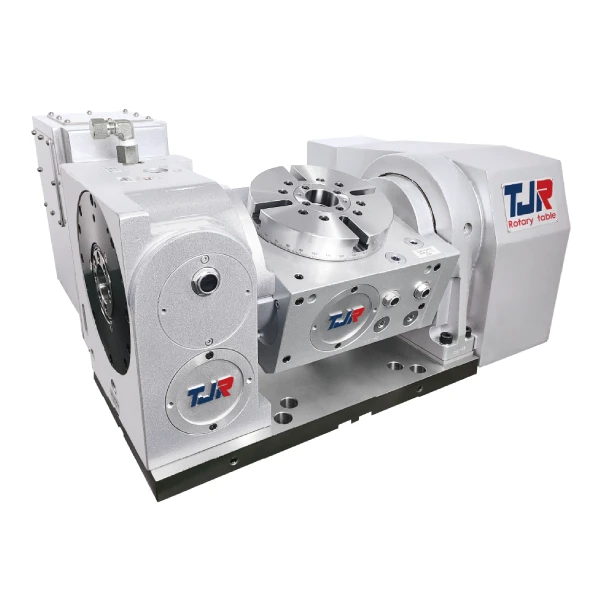
- TJR Roller Gear Cam and Hybrid Worm Rotary Table - FRC Ø320
TJR Roller Gear Cam and Hybrid Worm Rotary Table - FRC Ø320
Combined cam and worm technology for versatile, high-accuracy positioning.
FRC-320CF-RC320
FRC-320CF-RC320 Product Specifications
| Item | Data |
|---|---|
| Application | Vertical and Horizontal |
| Installation Mode | Add-on |
| Table diameter(mm) | Ø320 |
| Inner diameter of mandrel sleeve(mm) | Ø80H7 |
| Diameter of center through hole(mm) | Ø 80 |
| Table height (Horizontal)(mm) | 310 |
| Table T-slot width(mm) | 14H7 |
| Guide block width(mm) | 18h7 |
| Axis / Rotation | 360° |
| Axis / Tilt | -110°~+110° |
Frequently Asked Questions
The TJR FRC-320CF-RC320 has a table diameter of 320 mm (Ø320). Its larger table provides increased workholding capacity and a rigid platform for demanding 4th- and 5th-axis CNC machining applications.
The FRC-320CF-RC320 uses a roller cam transmission mechanism on both the rotary and tilt axes. The roller cam design provides high positioning accuracy, smooth movement, low wear, and minimal backlash, making it suitable for precision multi-axis machining. TJR's roller-drive technology is designed for high torque capacity and high repeatability.
The rotary axis provides a full 360° rotation, while the tilting axis has a range of -110° to +110°. This wide tilting range allows the FRC-320CF-RC320 to access multiple workpiece surfaces and complex machining angles for 5-axis CNC applications.
The rotary axis has an indexing accuracy of 20 arc-seconds and repeatability of 6 arc-seconds. The tilt axis provides 60 arc-seconds of indexing accuracy and 8 arc-seconds of repeatability. With a minimum incremental angle of 0.001°, the table is designed for precise positioning during multi-axis machining.
The FRC-320CF-RC320 uses hydraulic clamping on both the rotary and tilt axes. The clamping system operates at 3.5 MPa (35 kg/cm²), providing a rotary-axis clamping torque of 687 kgf·m and a tilt-axis clamping torque of 1,717 kgf·m for strong workpiece holding during machining.
The rotary axis can support a maximum workpiece load of 200 kg when positioned horizontally at 0°. When the rotary axis is tilted between 0° and 90°, the allowable workpiece load is 150 kg. The allowable horizontal inertia load capacity is 2.56 kg·m², so workpiece weight distribution should also be considered.
The rotary axis has a 1:60 speed reduction ratio and a maximum table rotation rate of 50 rpm. The tilt axis has a 1:120 reduction ratio and a maximum table rotation rate of 25 rpm. These values provide a balance between controlled movement, torque, and machining productivity.
The FRC-320CF-RC320 can be configured with major CNC servo motor systems including FANUC, Mitsubishi, Yaskawa, Siemens, Heidenhain, and Syntec. TJR's published motor specifications include FANUC αiF8 / βiS12 for the rotary axis and αiS12 / αiF12 / βiS12 for the tilt axis, along with Mitsubishi HG-154 for the rotary axis and HG-204 for the tilt axis. The servo configuration can be selected to suit the CNC control system used with the machine.
The FRC-320CF-RC320 has an Ø80 mm center through hole, with an Ø80H7 inner diameter for the mandrel sleeve. The table also features a 14H7 T-slot and an 18h7 guide-block width for accurate installation and workholding.
Yes. The FRC-320CF-RC320 is designed for both vertical and horizontal installation and combines a 360° rotary axis with a -110° to +110° tilting axis. Its roller-cam transmission, high clamping torque, precise positioning, and 200 kg horizontal workpiece capacity make it suitable for demanding 4th- and 5th-axis CNC machining applications.
Related Products
Request a Quote
Tell us about your requirements, and we will develop a tailored solution for you
Download Digital Product Catalogue
Download the brochure and see what precision looks like.
Built on Innovation and engineered for Excellence.
We deliver precision indexing and rotary solutions that meet the highest standards of performance, trusted by manufacturers who demand accuracy, reliability, and results at every stage of production.